
The modern workplace has blurred the lines between professional and personal life like never before. With smartphones buzzing with work emails at dinner tables and laptops tempting us from bedroom nightstands, the concept of “clocking out” has become increasingly abstract. Yet amid this always-on culture, work-life balance has emerged not as a luxury, but as a necessity for sustainable success and genuine well-being.
Work-life balance isn’t about dividing your time equally between work and everything else—it’s about finding a rhythm that allows you to meet professional obligations while preserving space for personal growth, relationships, and rest. It’s the art of working smarter rather than longer, setting boundaries that protect your energy, and creating a lifestyle that supports both career advancement and personal fulfillment.
The stakes have never been higher. Burnout rates have skyrocketed, mental health challenges are more prevalent, and the traditional boundaries that once separated work from home have dissolved. Understanding how to navigate these challenges isn’t just beneficial—it’s essential for anyone who wants to build a career that enhances rather than diminishes their quality of life.

Work life balance working from home setup with laptop and coffee
What Is Work-Life Balance?
Work-life balance refers to the equilibrium between the time and energy you devote to your career and the time you invest in other aspects of your life—relationships, hobbies, health, personal development, and rest. It’s a dynamic state that requires ongoing adjustment as your circumstances, responsibilities, and priorities evolve.
Common Misconceptions About Balance
Many people misunderstand what work-life balance actually means, which can lead to frustration and unrealistic expectations.
It doesn’t mean equal time. Work-life balance isn’t about spending exactly eight hours working and eight hours on personal activities. Some weeks require more professional focus; others allow more personal time. Balance is about feeling satisfied with how you’re allocating your energy over time.
It isn’t the same for everyone. Your ideal balance will look different from your colleague’s. A parent with young children, a recent graduate building a career, and someone nearing retirement all have different needs and definitions of balance. What matters is finding what works for your unique situation.
It’s not about working less. Balance doesn’t necessarily mean reducing your work hours. It’s about working more effectively during those hours, setting clear boundaries, and ensuring work doesn’t consume your entire identity and energy reserves.
It’s not a one-time achievement. Work-life balance isn’t something you achieve and maintain forever. Life circumstances change—new jobs, relationships, health challenges, or family responsibilities all require recalibrating your approach to balance.
Why Work-Life Balance Matters
The importance of work-life balance extends far beyond simply “feeling better.” It has measurable impacts on multiple aspects of your life and career.
Mental Health and Emotional Well-Being
Chronic overwork without adequate recovery time takes a serious toll on mental health. When work consistently encroaches on personal time, stress hormones remain elevated, leading to anxiety, depression, and emotional exhaustion. Research consistently shows that people who maintain healthier boundaries between work and personal life report lower stress levels, better mood stability, and greater overall life satisfaction.
The constant pressure to be available and productive can create a state of perpetual tension that affects sleep quality, emotional regulation, and relationships. When you prioritize balance, you give your mind the recovery time it needs to process experiences, regulate emotions, and maintain psychological resilience.
Productivity and Performance
Counterintuitively, working longer hours often leads to decreased productivity. Mental fatigue reduces cognitive function, impairs decision-making, and increases errors. When you maintain work-life balance, you return to work refreshed, focused, and more capable of producing high-quality work efficiently.
Studies have shown that people who take regular breaks, maintain boundaries, and prioritize rest actually accomplish more meaningful work than those who grind through long hours. The key is working with intention during work hours and fully disconnecting during personal time, rather than operating at half-capacity throughout all waking hours.
Physical Health
The connection between work-life balance and physical health is undeniable. Chronic work stress contributes to cardiovascular disease, weakened immune function, digestive issues, and chronic pain conditions. When work consistently takes priority over self-care activities like exercise, proper nutrition, and adequate sleep, your physical health suffers.
Maintaining balance creates space for health-promoting activities. Regular exercise, cooking nutritious meals, getting sufficient sleep, and attending medical appointments all require time and energy that disappear when work dominates your schedule.
Relationships and Social Connections
Strong relationships require time, presence, and emotional availability—all of which become scarce when work life overwhelms personal life. Whether it’s romantic partnerships, friendships, or family relationships, meaningful connections need nurturing. When work consistently takes precedence, relationships deteriorate, leading to isolation and reduced social support networks.
Quality time with loved ones isn’t just enjoyable; it’s essential for emotional health and provides the support system that helps you navigate professional challenges. People with strong personal relationships report higher job satisfaction and greater resilience in facing workplace stress.
Job Satisfaction and Career Sustainability
Paradoxically, maintaining work-life balance often leads to greater career success over the long term. When you prevent burnout and maintain enthusiasm for your work, you’re more likely to stay engaged, pursue growth opportunities, and build a sustainable career trajectory. Employee retention, job satisfaction, and career longevity all improve when people feel they can maintain a healthy relationship with work.
Signs of Poor Work-Life Balance
Recognizing when your balance has tipped too far toward work is crucial for making corrective changes before serious consequences develop.
Burnout Symptoms
Burnout is more than just feeling tired—it’s a state of physical, emotional, and mental exhaustion caused by prolonged stress. Warning signs include:
- Chronic fatigue that doesn’t improve with rest
- Cynicism or detachment from work
- Reduced productivity despite long hours
- A sense that nothing you do makes a difference
- Frequent headaches and muscle tension
- Digestive problems and weakened immunity
- Irritability and mood swings
- Loss of motivation and feelings of inadequacy
Chronic Stress Indicators
When work stress becomes chronic rather than episodic, your body remains in a constant state of fight-or-flight activation. This shows up as:
- Persistent anxiety and difficulty concentrating
- Racing thoughts and insomnia
- Physical tension throughout the body
- Constant preoccupation with work
- Inability to fully relax even during time off
Chronic stress also affects behavior—increasing reliance on unhealthy coping mechanisms like excessive caffeine, alcohol, or food, withdrawing from social activities, or neglecting responsibilities outside of work.
Lack of Personal Time
When was the last time you did something purely for enjoyment? If you can’t remember, or if hobbies and personal interests have completely fallen away, your balance has shifted too heavily toward work. Personal time isn’t frivolous; it’s essential for maintaining perspective, creativity, and sense of self beyond your professional identity.
Other red flags include:
- Regularly canceling personal plans for work
- Eating lunch at your desk most days
- Checking work email during family events
- Feeling guilty whenever you’re not working
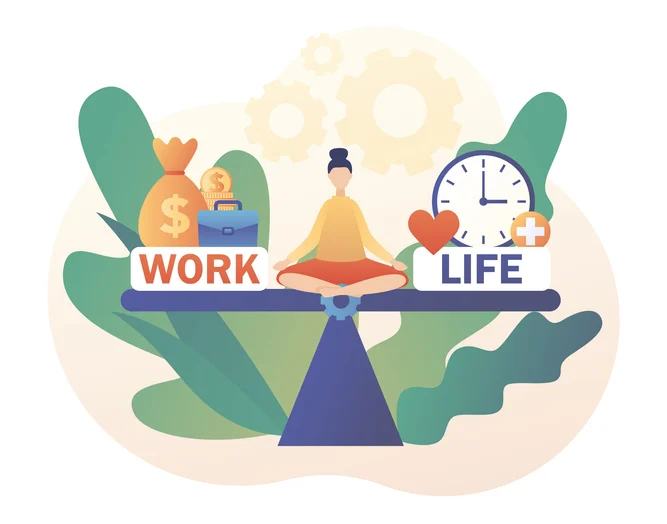
Healthy work life balance illustration showing career and personal life harmony
How to Improve Work-Life Balance
Improving your work-life balance requires intentional strategies and consistent practice. Here are evidence-based approaches that make a real difference.
Set Clear Boundaries
Boundaries are the foundation of work-life balance. This means establishing clear rules about when and how you’ll engage with work, then communicating and enforcing those boundaries.
Define your work hours. If you work 9-5, commit to truly ending work at 5 PM. Turn off work notifications on your phone after hours. Create a separate work email account that you only check during work hours if possible.
Create physical boundaries. If you work from home, designate a specific workspace and leave it at the end of the workday. Avoid working from your bedroom or other personal spaces that should remain associated with rest and relaxation.
Communicate clearly. Let colleagues, managers, and clients know when you’re available and when you’re not. Most professionals respect clearly stated boundaries more than we assume they will.
Prioritize Tasks Effectively
Not all work tasks carry equal importance. Learning to distinguish between urgent and important tasks prevents you from spending all your time on reactive work that doesn’t move meaningful goals forward.
Use prioritization frameworks. The Eisenhower Matrix helps you categorize tasks by urgency and importance. Focus your energy on tasks that are both important and urgent first, then on important but non-urgent tasks.
Delegate strategically. Learn to identify which tasks truly require your unique skills and which could be handled by others. Delegation isn’t shirking responsibility; it’s strategic resource allocation that allows you to focus on high-value work while developing others’ capabilities.
Eliminate low-value tasks. Many people spend too much time on urgent but unimportant tasks—these are often good candidates for delegation or elimination entirely.
Manage Time Effectively
Effective time management isn’t about cramming more activities into your day—it’s about using your time intentionally and protecting space for both productivity and recovery.
Try time blocking. Instead of maintaining an open-ended to-do list, assign specific time blocks to specific tasks. This creates structure and helps prevent work from expanding to fill all available time.
Batch similar tasks together. Answering emails, making phone calls, or attending meetings in dedicated blocks rather than sporadically throughout the day improves efficiency and reduces the mental fatigue of constant context-switching.
Build buffer time. Back-to-back meetings and commitments leave no room for processing, preparation, or unexpected issues. Even 15-minute buffers between major tasks can significantly reduce stress.
For more comprehensive strategies, explore our guide on time management strategies that can help you work more efficiently and create space for personal priorities.
Take Regular Breaks
Your brain wasn’t designed for sustained focus over long periods. Taking regular breaks actually improves productivity by allowing mental recovery and maintaining cognitive performance.
Use the Pomodoro Technique. Work in 25-minute focused intervals followed by 5-minute breaks, with longer 15-30 minute breaks after every four intervals. Even if this specific structure doesn’t work for you, the principle holds: regular short breaks prevent mental fatigue.
Step away from your desk. Physical movement, even just a short walk, improves circulation, reduces muscle tension, and provides mental refreshment. Looking away from screens and engaging different parts of your brain helps maintain focus when you return to work.
Take real lunch breaks. Eating while working might seem efficient, but it prevents the mental disengagement that makes a real difference in afternoon productivity. Even a 20-minute lunch away from your desk provides valuable recovery time.
Learn to Say No
One of the most powerful work-life balance skills is learning to decline commitments that don’t align with your priorities or that would overextend your capacity.
Keep it simple. Saying no doesn’t require elaborate justifications. Simple, polite responses like “I appreciate you thinking of me, but I don’t have capacity for this right now” or “That doesn’t align with my current priorities” are sufficient.
Pause before committing. Before automatically saying yes to requests, evaluate whether the commitment truly serves your goals and whether you have realistic capacity to fulfill it well. Consider the opportunity cost—saying yes to one thing means saying no to something else, even if that something else is rest or personal time.
Create space for the right opportunities. Remember that saying no to opportunities that aren’t right for you creates space to say yes to opportunities that are aligned with your values and goals.
Understanding your limits and avoiding overcommitment is crucial for preventing burnout. Learn more in our article about avoiding burnout at work.
Work-Life Balance in Remote and Hybrid Work
The rise of remote and hybrid work arrangements has fundamentally changed the work-life balance equation, creating both opportunities and challenges.
The Advantages
Time savings. Remote work eliminates commute time, potentially saving hours each week that can be redirected toward personal activities, family time, or rest.
Greater flexibility. The ability to structure your workday around personal needs—starting earlier to finish earlier, or taking a midday break for exercise—can significantly improve quality of life.
Improved focus. Working from home can reduce workplace distractions, allowing for deeper focus during peak productivity hours. Many remote workers report feeling more productive because they can create environments optimized for their individual work styles.
The Challenges
Blurred boundaries. When your home is your office, “leaving work” becomes purely psychological rather than physical. The temptation to check “just one more email” or tackle “one quick task” can extend work hours indefinitely.
Pressure to overwork. Remote workers often struggle with overworking because the visible signs of effort—being at the office, working long hours—are absent. This can create pressure to prove productivity by being constantly available or working longer hours than necessary.
Isolation. Without casual workplace interactions, remote workers can feel disconnected from colleagues and miss the social aspects of work that provide community and support.
Strategies for Remote Work Balance
Create a dedicated workspace. Even if it’s just a specific corner of a room, having a designated work area helps create psychological separation that you can physically leave at the end of the workday.
Establish transition rituals. Create a “commute” ritual that marks the shift between work and personal time. This might be a short walk, a workout, changing clothes, or simply shutting down your computer and putting it away.
Communicate availability explicitly. Use calendar blocking to show when you’re working and when you’re unavailable. Set clear expectations about response times for messages sent outside work hours.
Maintain social connections intentionally. Schedule virtual coffee chats with colleagues, participate in team activities, and make time for in-person interactions when possible. These connections are important for both collaboration and mental health.

Improving work life balance daily habits including exercise and time management
Small Daily Habits That Make a Big Difference
Sustainable work-life balance comes from consistent small practices rather than dramatic overhauls. Here are daily habits that compound over time.
Morning Routines
How you start your day sets the tone for everything that follows.
Avoid work first thing. Don’t check work email or messages immediately upon waking. Instead, begin with activities that ground you—exercise, meditation, a healthy breakfast, or time with family.
Keep it simple and consistent. Even a 15-minute morning routine that includes something nurturing or energizing can significantly impact your mental state throughout the day. This might include journaling, reading, stretching, or simply sitting with coffee without digital distraction.
Make it sustainable. A simple routine performed daily is more valuable than an elaborate routine you can’t maintain.
Digital Detox Practices
Constant digital connectivity is one of the biggest threats to work-life balance. Implementing regular digital detox practices helps reclaim mental space and presence.
Designate phone-free times. Avoid devices during meals, the first hour after waking, or the hour before bed. Keep devices out of the bedroom to improve sleep quality and reduce the temptation for late-night work sessions.
Turn off non-essential notifications. Most notifications aren’t truly urgent and primarily serve to fragment your attention. Batch checking messages at designated times rather than responding instantly to every ping.
Try a digital sabbath. Consider a weekly digital sabbath—a day or half-day where you completely disconnect from work-related technology. This creates space for deeper rest and helps you remember what life feels like without constant work accessibility.
Scheduling Personal Time
The things that matter most in life rarely feel urgent in the moment, which means they’re often displaced by things that feel pressing but aren’t truly important. Combat this by literally scheduling personal priorities.
Calendar personal activities. Put exercise on your calendar like any other appointment. Block time for hobbies, family activities, or social connections. When personal time is scheduled rather than left to “whenever I have time,” it’s much more likely to actually happen.
Honor personal commitments. Treat these personal commitments with the same respect you give professional obligations. Don’t cancel personal time automatically when work demands arise—evaluate whether the work truly requires immediate attention or if it can wait.
Building wellness habits that support both productivity and personal well-being creates a foundation for sustainable balance. Explore more ideas in our article on wellness and productivity habits.
Conclusion
Work-life balance isn’t a destination you reach and then maintain effortlessly—it’s an ongoing practice of making intentional choices about how you spend your time and energy. In a culture that often celebrates overwork and hustle, choosing balance is a radical act of self-preservation and wisdom.
You cannot pour from an empty cup. Sustainable professional success requires protecting the personal foundation that supports your work. When you prioritize rest, relationships, health, and personal interests, you don’t become less effective at work—you become more focused, creative, and resilient.
Start small. You don’t need to overhaul your entire life immediately. Choose one strategy from this article—setting a boundary, implementing a morning routine, scheduling personal time—and practice it consistently. Small changes compound into significant transformation over time.
Balance is personal and dynamic. Work-life balance looks different for everyone and will shift throughout your life as circumstances change. What matters is regularly checking in with yourself, assessing whether your current balance serves your well-being and values, and making adjustments when needed.
Aim for patterns, not perfection. Some weeks will be more work-heavy; others will allow more personal focus. What matters is the overall pattern and your ability to recognize when balance has tipped too far in one direction and needs correction.
Take Action Today
Your work-life balance won’t improve by accident—it requires conscious intention and consistent action.
Assess your current situation. Where does your time actually go? What boundaries do you need to establish? What personal priorities have you been neglecting?
Choose one small change. Maybe it’s leaving work on time three days this week, scheduling one lunch away from your desk, or turning off work notifications after 7 PM. Commit to this change and notice the difference it makes.
Subscribe for ongoing support. Want more strategies for creating a more balanced, sustainable work life? Subscribe to our blog for regular insights on productivity, wellness, and professional development. You’ll receive practical tips and evidence-based strategies delivered directly to your inbox.
Remember: Investing in your well-being isn’t selfish—it’s essential for building a career and life that you can sustain and enjoy for the long term. Your future self will thank you for the boundaries you set and the balance you create today.