
How to show up fully for the people you love — while protecting your own peace, energy, and sense of self.
Have you ever said yes when you desperately wanted to say no? Have you found yourself exhausted, resentful, or emotionally drained after spending time “helping” someone you care about? If so, you’re not alone — and this blog post is written with you in mind.
Healthy boundaries are one of the most powerful tools you have for building meaningful, balanced relationships. They are not walls that keep people out. They are not selfish acts. They are the invisible lines that define where you end and where others begin — and learning to set them is one of the most loving things you can do for yourself and for the people you care about.
In this comprehensive guide, we’ll explore what healthy boundaries actually look like, why they matter for your mental and physical well-being, and — most importantly — how to support the people in your life without losing yourself in the process.

Two friends sitting in a sunny garden having a meaningful conversation, illustrating healthy, supportive communication.
67% of caregivers report burnout from poor personal boundaries
3x more likely to experience anxiety without consistent limits
82% of therapists cite boundary-setting as a core life skill
What Are Healthy Boundaries?
At their core, healthy boundaries are the guidelines, rules, and limits that you set for yourself in relationships — defining what behaviors you will and won’t accept, what you’re willing to give, and what you need in return. They are an expression of self-awareness and self-respect.
Psychologists describe boundaries as existing on a spectrum. On one end you have rigid boundaries — walls so thick that no one can get in, which leads to isolation and loneliness. On the other end are porous or diffuse boundaries — situations where you have little definition between yourself and others, often leading to over-involvement, codependency, and emotional overwhelm. Healthy boundaries sit in the balanced middle: they are firm enough to protect you, yet flexible enough to allow genuine intimacy and connection.
The concept of boundaries is deeply rooted in the work of family therapist Salvador Minuchin, whose structural family therapy in the 1970s emphasized that clear, flexible boundaries within families lead to better psychological health. Since then, therapists, coaches, and wellness researchers have expanded the concept far beyond family systems into all areas of life — friendships, work relationships, romantic partnerships, and even digital interactions.
“Daring to set boundaries is about having the courage to love ourselves, even when we risk disappointing others.” — Brené Brown
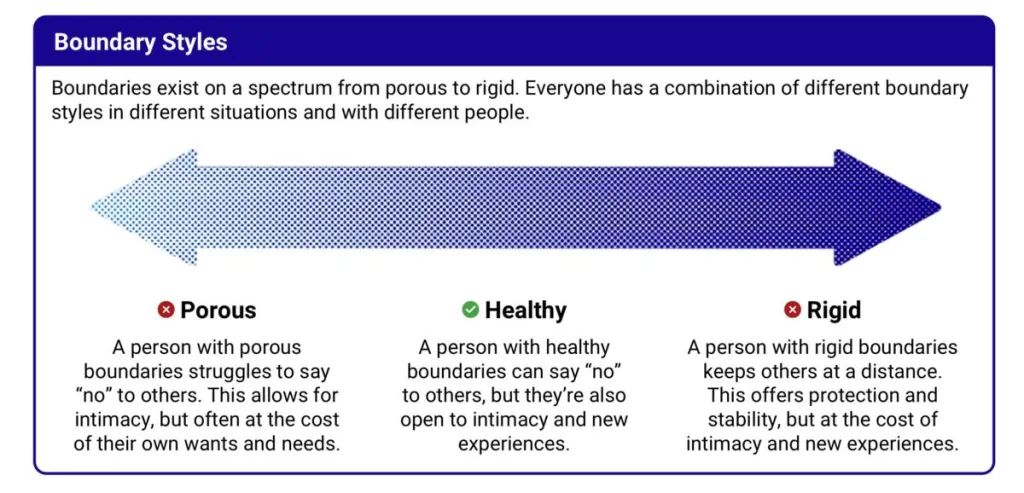
An illustrated infographic showing the boundaries spectrum from rigid boundaries on the left to porous boundaries on the right, with healthy boundaries in the center.
Why Healthy Boundaries Matter for Your Wellbeing
You might be wondering: why make such a big deal about setting limits with people you love? The answer lies in what happens to you — psychologically, physically, and emotionally — when you don’t.
When you consistently override your own needs to accommodate others, you enter a state that psychologists call self-neglect. Over time, this erodes self-esteem, increases anxiety and depression, and creates a deep well of resentment in even the most loving relationships. The very connection you were trying to protect begins to deteriorate — because you’ve disappeared inside it.
On the flip side, when boundaries are in place, research shows remarkable benefits across multiple dimensions of health. A 2019 study published in the Journal of Health Psychology found that people who reported clear personal limits in their social relationships had significantly lower cortisol levels (the stress hormone), better sleep quality, and higher levels of life satisfaction. Setting boundaries, in other words, is not just emotionally healthy — it has measurable physiological benefits.
The Benefits of Healthy Boundaries
- Reduced stress, anxiety, and emotional exhaustion
- Stronger, more authentic relationships built on mutual respect
- Greater sense of personal identity and self-worth
- More time and energy for what truly matters to you
- Protection from manipulation, guilt-tripping, and emotional abuse
- Improved ability to empathize without over-identifying with others’ pain
- Healthier conflict resolution and clearer communication
It’s also worth emphasizing that boundaries are not about punishing others or withdrawing love. In fact, they do the opposite — they create the conditions for deeper, more sustainable love. When both people in a relationship feel safe to be themselves and know their limits will be respected, trust deepens and connection flourishes.
Learn more about Guru here — find guidance today.
Ready to Protect Your Energy?
Download our free Boundary-Setting Workbook — a step-by-step guide with journal prompts, scripts, and real-life scenarios to help you define and communicate your limits with confidence.
Signs You May Be Missing Healthy Boundaries
Many people live for years — even decades — without realizing their boundaries are compromised. Our culture often rewards selflessness, endurance, and “being there” for others at all costs. It’s easy to mistake over-giving for virtue. Here are some signs that you may need to reassess your personal limits.

A tired person sitting at a desk with head in hands, representing burnout and emotional exhaustion from a lack of personal boundaries.
Emotional and Relational Warning Signs
- Chronic resentment. You feel frustrated or bitter toward people you love, often because you’ve given more than you truly wanted to.
- Difficulty saying no. Even when you’re overwhelmed, the word “no” feels impossible — followed by immediate guilt if you do manage to say it.
- Over-responsibility for others’ emotions. You feel personally responsible for making everyone around you happy, calm, or comfortable.
- Losing your identity. You’ve forgotten your own preferences, opinions, and needs — your life revolves around others’ desires.
- Fear of conflict or rejection. You agree with people to keep the peace, even when you strongly disagree.
- Emotional exhaustion after interactions. Spending time with certain people leaves you feeling drained, depleted, or empty rather than energized.
- Tolerating disrespectful behavior. You allow others to speak to you dismissively, cancel plans last-minute, or take advantage of your generosity — repeatedly.
If several of these resonate with you, please know: this is not a character flaw. For many of us, poor boundary habits are learned in childhood, shaped by cultural messages, or developed as survival strategies in difficult relationships. Recognizing the patterns is the powerful first step toward changing them.
You might also want to explore our post on wellness and productivity hacks for long-term success — So you can continue to love yourself and be productive.
The Different Types of Boundaries You Can Set
Boundaries are not one-size-fits-all. They span multiple domains of life, and knowing the different categories can help you identify where your own limits may be weakest.
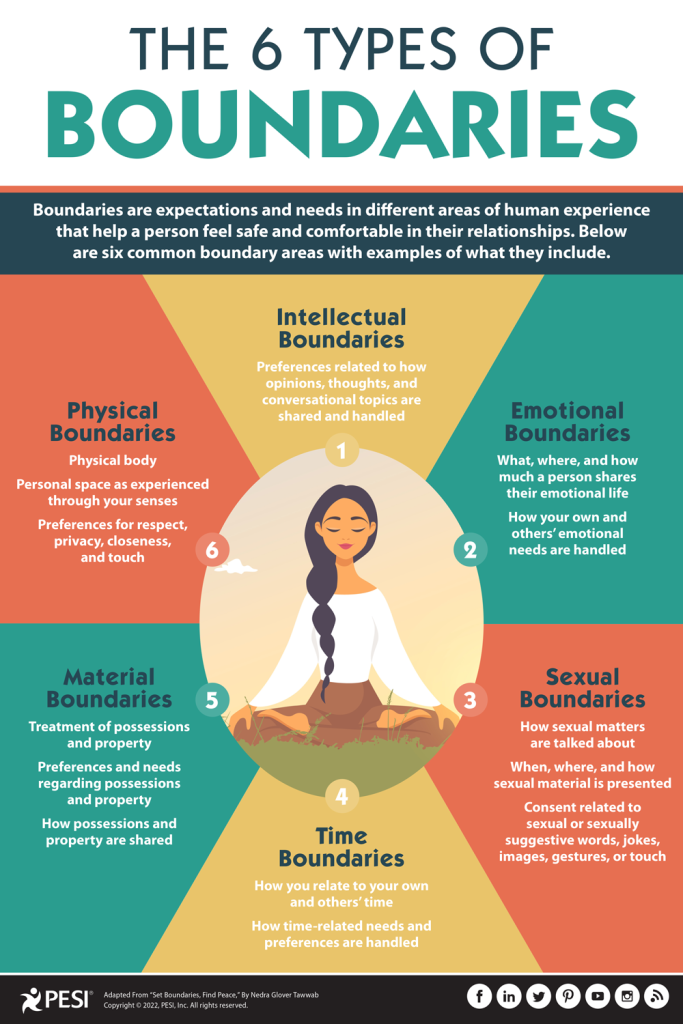
A visual grid showing six types of personal boundaries: emotional, physical, time, energy, digital, and financial, each represented by an icon.
1. Emotional Boundaries
These protect your feelings and emotional energy. They involve recognizing that you are not responsible for managing other people’s emotions — and that you have the right to your own feelings without being criticized, dismissed, or invalidated. Emotional boundaries sound like: “I’m not able to talk about this right now” or “I need you to stop yelling before we continue this conversation.”
2. Physical Boundaries
Physical boundaries relate to your personal space, touch, and physical comfort. They are the right to say who touches your body, how, and when — and to have your physical space respected. These apply in personal relationships but are equally important in professional settings.
3. Time and Energy Boundaries
Your time is finite. Time boundaries mean protecting your schedule from being consumed by others’ demands. This includes saying no to requests that don’t align with your priorities, ending conversations that go on too long, and protecting your rest time. Energy boundaries go hand-in-hand — they involve recognizing which relationships and activities replenish you and which deplete you, and structuring your life accordingly.
4. Mental and Intellectual Boundaries
These protect your right to have your own thoughts, beliefs, and opinions — even when they differ from those around you. Mental boundaries mean you don’t have to defend your values or justify your perspectives to people who are unwilling to engage respectfully.
5. Financial Boundaries
Money is one of the most common sources of boundary violations in families and friendships. Financial boundaries involve being clear about what you will and won’t lend, give, or subsidize — and not feeling obligated to share your financial details with people who pressure you.
6. Digital and Online Boundaries
In our hyper-connected world, digital boundaries are increasingly important. They include how quickly you respond to messages, whether you share your location, what you post publicly, and how you manage your relationship with devices and social media. You have the right to be unreachable — even in the age of instant messaging.
How to Set Healthy Boundaries Without Guilt
Knowing you need boundaries is one thing. Actually setting them — especially with people you love — is another challenge entirely. The guilt, the fear of disappointing others, the worry about how you’ll be perceived: these are real obstacles. Here’s a step-by-step approach to setting limits in a way that is both firm and compassionate.

A confident person with open body language having a calm conversation, representing assertive and respectful boundary-setting.
- Get clear on what you need. Before you can communicate a boundary, you need to know what it is. Journal about situations that make you feel resentful, taken advantage of, or depleted. Those feelings are boundary signals.
- Use “I” statements. Frame your limits in terms of your own needs, not the other person’s behavior. “I need some alone time after work before we talk” lands very differently than “You’re always pestering me the second I get home.”
- Be specific and direct. Vague limits are easily misunderstood. “I need more space” is unclear. “I’d like us to text rather than call during my work hours, except for emergencies” is actionable.
- State consequences calmly. A boundary without a consequence is just a wish. If a limit is crossed, calmly state what will happen: “If you continue raising your voice, I’m going to end this call and we can talk later when things have calmed down.”
- Expect pushback — and prepare for it. When you start setting limits with people who aren’t used to them, they will often push back. This doesn’t mean you’re wrong. It means you’re changing a dynamic. Hold your ground with compassion.
- Practice consistency. Boundaries only work when they’re enforced consistently. If you set a limit and then repeatedly allow it to be crossed, others learn they can ignore it. Consistency is an act of self-respect.
- Start small. If setting limits feels overwhelming, start with lower-stakes situations. Practice saying no to small requests before tackling the big ones. Like any skill, this gets easier with repetition.
“You teach people how to treat you by what you allow, what you stop, and what you reinforce.” — Tony Gaskins
Want to Learn This in Community?
Join our monthly Boundaries & Balance Workshop — a live virtual session where we practice real-life conversations, work through guilt, and build healthier relationship habits together.
Supporting Others While Protecting Yourself
Here’s the part that most boundary conversations miss: how do you maintain deep, caring, generous relationships while protecting your own well-being? Is it possible to be truly supportive without burning out?
The answer is yes — and the key lies in understanding the difference between helping from abundance versus helping from depletion.
When you help from a place of genuine choice, when your own needs are met, when you’re not operating on an empty tank — that help is sustainable, joyful, and genuinely empowering for the person receiving it. When you help because you feel obligated, guilty, or afraid of someone’s reaction, you’re helping from a deficit. That kind of support is fragile, resentment-prone, and often subtly disempowering — it keeps the other person dependent rather than helping them grow.

A group of hikers on a trail helping each other navigate a rocky path, symbolizing supportive relationships that respect everyone’s footing and capacity.
Practical Ways to Support Without Losing Yourself
- Check in with yourself first. Before saying yes to a request for support, pause and ask: Do I genuinely have the capacity for this right now? Support given when you’re already running low will cost you more than it gives.
- Offer what you can truly give. Instead of overcommitting and under-delivering, offer what you can actually sustain. “I can’t talk for an hour tonight, but I can check in for 15 minutes” is more loving than a strained two-hour call.
- Separate empathy from over-identification. You can care deeply about someone’s pain without absorbing it as your own. Learn to hold space for others’ emotions without taking them on.
- Encourage their resourcefulness. The most empowering support helps people build their own capacity — not permanent reliance on you. Ask: “What do you think you could try?” alongside your own suggestions.
- Set time limits on heavy conversations. “I want to be fully present for you, so let’s give this 30 minutes tonight” is not unkind — it’s honest and sustainable.
- Replenish yourself regularly. Whatever fills your cup — solitude, exercise, creativity, time in nature — protect that time fiercely. You cannot pour from an empty vessel.
Common Challenges and How to Overcome Them
Even with the best intentions and clearest strategies, setting and maintaining healthy limits is genuinely hard. Let’s address some of the most common challenges people face.

A person standing at a forked path looking thoughtful, representing the challenge of navigating difficult decisions around setting and maintaining personal boundaries.
Challenge 1: Guilt
Guilt is perhaps the most universal barrier. Many of us — especially those raised in cultures or families where self-sacrifice was rewarded — feel an automatic wave of guilt whenever we prioritize ourselves. It’s important to understand that guilt is a feeling, not a fact. It doesn’t mean you’ve done something wrong. It often means you’ve done something new. Over time, as you practice self-advocacy, the guilt typically diminishes.
Challenge 2: Fear of Damaging the Relationship
A common fear is: “If I set this limit, they’ll pull away or get angry, and I’ll lose the relationship.” This fear is understandable — but here’s the reframe: a relationship that can only function when you have no limits is not a healthy relationship. People who genuinely love and respect you will ultimately honor your limits, even if there’s initial friction.
Challenge 3: Dealing With Boundary Violations
Even after you’ve clearly communicated a limit, some people will test or ignore it. When this happens, calmly reiterate your boundary and follow through on your stated consequence. Avoid lengthy explanations or justifications — you don’t need to defend your needs. Consistency is key. Each time you enforce a limit, you signal that it’s real and that you mean what you say.
Challenge 4: Boundaries with Family Members
Family can be the hardest place to implement limits. Years of established dynamics, cultural expectations, and emotional history make it feel almost impossible to change the rules. Start slowly, be patient with yourself, and consider working with a therapist if family boundaries are a significant source of distress. You deserve to read more about this topic — our guide on How Speaking to an Expert can change your life will guide you.
Challenge 5: Digital Overreach
Being reachable 24/7 has become the cultural norm — but it’s not a requirement. Consider establishing specific windows during which you respond to messages, and communicate that clearly to the people in your life. Protecting your digital boundaries protects your mental space, your focus, and your rest.
Is a Mentor Right for You?
Setting limits in deeply entrenched relationships can feel impossible alone. Our resource guide connects you with vetted boundary-informed therapists and coaches for one-on-one support. Find Your Mentor

A person standing peacefully outdoors journaling in the sunshine, representing the importance of self-care and personal restoration as part of healthy boundary maintenance.
Putting It All Together
Learning to set healthy boundaries is one of the most transformative journeys you can undertake. It will change how you relate to yourself, how you show up in relationships, and how much joy and energy you carry through your days.
It’s not a one-time action — it’s a lifelong practice. There will be days when the guilt feels loud, when old patterns reassert themselves, when you give more than you should have. That’s okay. Every moment is a chance to recalibrate and come back to yourself.
What you’ll discover, slowly but unmistakably, is that limits do not reduce love — they deepen it. They create the safety and clarity within which true intimacy can grow. The people who are meant to be in your life will meet your limits with respect, even if they need time to adjust. And you’ll find that you can support them — genuinely, generously, and sustainably — from a place of wholeness rather than depletion.
You deserve relationships where showing up doesn’t mean disappearing. You deserve to support others and yourself. And the beautiful truth is: those two things are not in conflict. In fact, the healthier your limits, the more you have to give.
For further reading, explore our blog posts on https://askanexpertguru.com/blog/
Take the First Step Today
© 2026 Rooted & Whole · Privacy Policy · Contact
This blog post is for educational purposes only and does not constitute professional mental health advice. Please consult a licensed therapist for personalized support.